To get SEO clients, choose a niche, show proof that you can help, and then keep a steady weekly routine of outreach, referrals and useful content instead of waiting for leads to arrive. The nine ways below work for freelancers and small agencies. Each starts with something useful for the prospect, and none needs cold calling.
It is written by the maker of SEOSage, an SEO audit app with branded client reports. Audits are the thread through this guide, because a specific finding on a prospect’s own site is the easiest way to start a conversation.
TL;DR
- Get clear on three things first: who you help, what you offer in plain words, and one piece of proof.
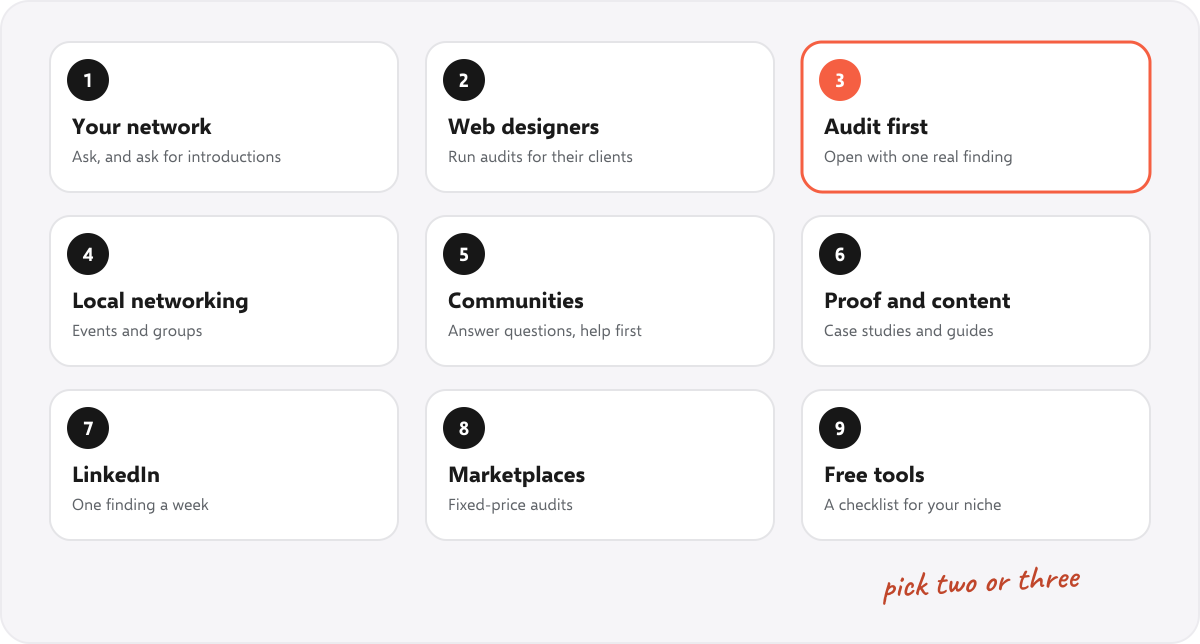
- Nine ways to find clients: your network, web designers, audit-first outreach, local networking, communities, proof and content, LinkedIn, freelance marketplaces and free tools.
- Pick two or three and run them every week. A routine beats a burst of effort.
- Start every conversation with something about their site, not about your services.
- Track every prospect in one simple sheet, and follow up.
How do you get SEO clients? #
You get SEO clients by being easy to find, easy to trust and easy to say yes to. Easy to find means being where your clients look: with people who know them, in the places they ask questions, and in front of them with a useful message. Easy to trust means showing proof. Easy to say yes to means a small first offer, such as an audit with a fixed price. Our guide to how to sell SEO services covers the selling step. This guide covers the finding.
What do you need before you start? #
- A niche. “Dentists”, “online shoe stores” or “software companies” is easier to find and to understand than “everyone with a website”.
- A simple offer. One sentence that says what you do and what the client gets, such as “I find why your site is not getting found and fix it in three months”.
- One piece of proof. A case study, a before-and-after crawl or a sample audit. If you have no clients yet, audit a few sites in your niche for practice, or your own site.
- A page that explains it, with a way to contact you.
- A way to show value quickly. A 30-minute audit of the prospect’s site is the tool used in the rest of this guide. See what an SEO audit is and how to do one.
What are the nine ways to get SEO clients? #
1. Ask your network and past clients #
The easiest first client is someone who already knows you. Tell former colleagues, clients and friends exactly what you do and who you help, and ask who they know. People forward a clear sentence much more easily than a vague one. After every finished project, ask for a short testimonial and an introduction.
2. Partner with web designers and developers #
Designers and developers build sites and are often asked about SEO. Many would rather hand it to someone reliable. Offer to run the audit for their clients and send back a report with their own logo. A white label setup, with your branding or theirs on the report, makes it easy for them. See what white label SEO is and the white label SEO audit tool.
3. Audit first, then reach out #
Pick businesses in your niche, crawl their sites and look for one clear, checkable problem, such as pages hidden from Google. Write to the owner about that one finding and offer to share three more. It works because it is about them, it is specific and it costs them nothing. Use a real finding every time and never invent one. Our guide to selling SEO has the email script. For local businesses, the local SEO audit gives you twelve checks.
4. Go where local businesses meet #
Local business groups, chamber of commerce events, co-working spaces and industry meetups put you in a room with owners who need leads. Do not pitch. Ask about their business, and offer a quick look at their site afterwards.
5. Answer questions where your clients ask them #
Owners ask SEO questions in online communities, forums and groups. Give a real, short answer that helps, without a link at first. People remember who was useful. Over time, your profile and your answers become a reason to contact you. Follow each community’s rules about promotion.
6. Publish proof and helpful content #
A case study, a short audit of a well-known type of site, or a clear guide to a problem your niche has all work for you while you are doing other things. Show real numbers, from your own work, and say what you did. Use your own site to show that SEO works: a few pages that rank for your niche are the best advert you can have.
7. Share findings on LinkedIn #
Post one short finding a week, such as a common mistake you see in your niche, with a picture. Connect with owners and managers in your niche, comment usefully on their posts and message people who respond. LinkedIn works for B2B clients, such as software and professional services firms.
8. Use freelance marketplaces carefully #
Freelance marketplaces have buyers, but they also have price pressure and many competitors. They are useful for a first few projects and reviews. Offer a fixed-price audit rather than open-ended hours, and aim to move good clients to a direct relationship.
9. Offer a free tool or checklist #
A useful free resource attracts people who are looking for help. Examples are an audit checklist, a report template or a proposal template. We do this ourselves, with a free technical SEO audit checklist and an SEO proposal template. Make one thing for your niche and put your contact details on it.
Which ways work best for which kind of client? #
Different clients are found in different places. Use this table to choose your two or three:
| Client type | Where to look first | Why |
|---|---|---|
| Local businesses | Local events, audit-first outreach, web designers | Owners decide fast and respond to a plain finding about their own site. See the local SEO audit. |
| Online stores | Audit-first outreach, communities for store owners | Stores have clear, checkable problems, such as removed products. See the ecommerce SEO audit. |
| Software companies | LinkedIn, content, partnerships with other agencies | Buyers are on LinkedIn and read guides. See the SaaS SEO audit checklist. |
| Professional services firms | Referrals, LinkedIn, local networking | They buy on trust, so introductions work best |
| Other agencies and designers | Partnerships and white label | One partner can bring many clients |
Whatever you choose, give each channel a fair trial of a few weeks before you judge it. A single week is too short to know.
What does a weekly routine look like? #
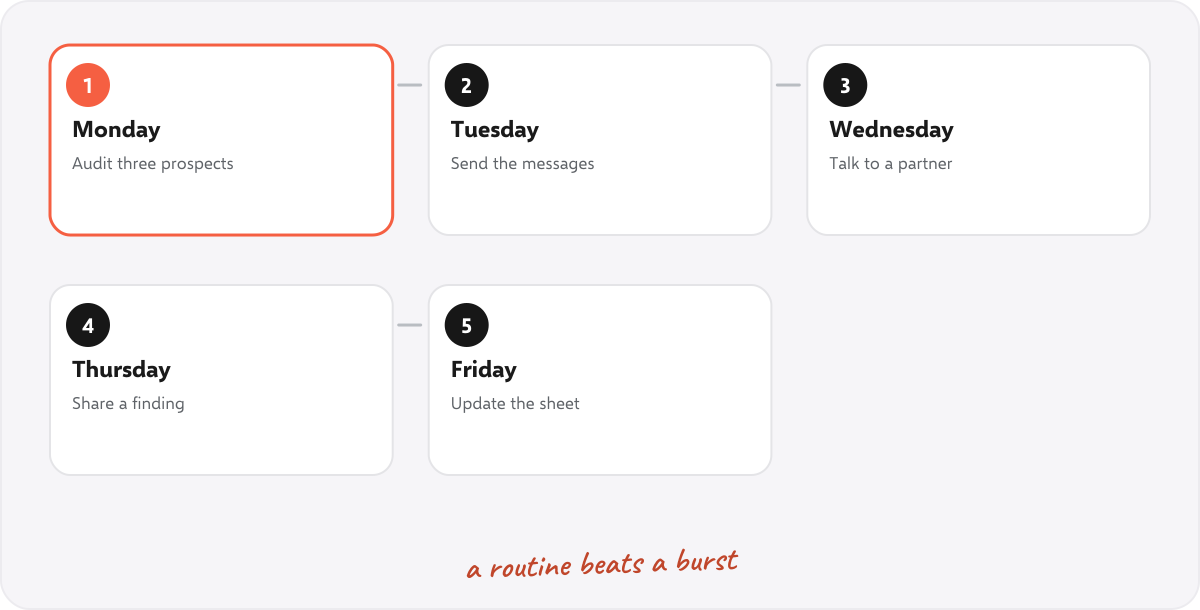
Consistency matters more than volume. Here is a routine for a freelancer with a few hours a week, which you can scale up:
| Day | Task | Time (suggested) |
|---|---|---|
| Monday | Crawl and audit three prospects in your niche. Note one finding each. | 90 minutes |
| Tuesday | Send the three messages. Follow up on last week’s. | 45 minutes |
| Wednesday | Talk to one possible partner, such as a web designer. | 30 minutes |
| Thursday | Share one finding or case study on LinkedIn, and answer two questions in a community. | 45 minutes |
| Friday | Update the tracking sheet, and book the calls for next week. | 30 minutes |
Track every prospect in one sheet with the name, the finding, the date you wrote, the reply and the next step. The times are a suggestion, not a rule.
How do you choose which prospects to contact? #
- They sell something valuable, so a few new customers pay for your work.
- Their site has a real, fixable problem that you can see in a crawl.
- The person you write to can decide. Look for the owner or marketing lead.
- They are in your niche, so you can write about what you know.
- They do not already have a busy agency. A site with a clear, recent blog is often served already.
What should you say in the first message? #
Keep it short, and make it about them. Here is a LinkedIn message you can adapt:
Hi [name], I looked at [website] today and noticed that [one finding, such as “14 pages are hidden from Google by a tag left on from the site build”]. It is a small fix with a big effect on those pages. I wrote up three findings like this. Want me to send them over?
Replace the finding with a real one every time. See our guide to the audit-first selling method for the full email and the answers to common objections, and our SEO proposal template for what to send next.
How does SEOSage help you get clients? #
SEOSage is a desktop SEO audit app for Mac and Windows that crawls on your own computer with no page limit. It helps at three points. It finds the findings you open with. It makes a branded PDF, PowerPoint, Excel or CSV audit with your logo to send to prospects, on every plan. And it crawls again every month, so your reports show progress. Plans start at $9 a month, and the free trial lasts 14 days. It does not find prospects for you, and it has no keyword or backlink database.
How long does it take to get your first SEO client? #
It depends on your niche, your network and how much time you put in, so no honest number exists. What you can measure are the steps that lead to clients: audits sent, replies, calls and proposals. If you send messages every week and do not get replies, change the message or the niche. If you get calls and no yeses, look at the offer and the proposal.
Common mistakes when getting SEO clients #
- Selling “SEO” to everyone. A niche makes you easier to remember and to refer.
- Leading with your services. Lead with something about their site.
- Sending the same message to hundreds. Each message needs one real finding.
- Doing it in bursts. A weekly routine beats a month of effort followed by silence.
- Not following up. Most replies come after the second or third message.
- Working for very low prices to get started. Offer a small fixed-price first project instead.
Summary #
To get SEO clients, pick a niche, make a simple offer, collect one piece of proof and then run a weekly routine of two or three of the nine ways: referrals, designers, audit-first outreach, local networking, communities, content, LinkedIn, marketplaces and free tools. Start every conversation with a real finding about the prospect’s own site, and track every prospect.
FAQ #
How do I get my first SEO client? #
Start with people who already know you, offer a small fixed-price audit, and use a real finding from their site as the reason to talk.
How do I get SEO clients without cold calling? #
Use referrals, partnerships with web designers, written outreach based on an audit finding, local networking, LinkedIn and useful content. None needs a phone call to start.
How do I get local SEO clients? #
Go to local business events, audit the sites of businesses near you and open with one finding, and partner with local web designers. See our local SEO audit guide.
How do I get SEO clients on LinkedIn? #
Share one short finding a week, connect with owners and managers in your niche, comment usefully on their posts and message the people who respond.
Do I need a portfolio to get SEO clients? #
You need one piece of proof. A case study, a before-and-after crawl or a sample audit of a site in your niche is enough to start.
Is a free SEO audit a good way to get clients? #
Yes, when it contains a real finding and no obligation. Do not send an audit with invented problems.
How do I find clients as a freelance SEO? #
Pick a niche, build a simple offer, and use two or three of the nine ways in a weekly routine.
What tools do I need to get SEO clients? #
A crawler for the audits, Google Search Console, a tracking sheet and a report format that carries your logo. SEOSage covers the crawler and the report.