To sell SEO services, show a prospect a specific problem on their own website, offer to fix it as a small first project, and prove the results with a report every month. The method has six steps, and it starts with an audit instead of a pitch. This guide gives you the steps, the scripts and the answers to the questions prospects ask.
It is written by the maker of SEOSage, an SEO audit app with branded client reports, so the method leans on audits and reports. We say plainly where a tool helps and where selling is just selling.
TL;DR
- SEO is hard to sell because it is invisible, slow and full of jargon. Make it visible with an audit of the prospect’s own site.
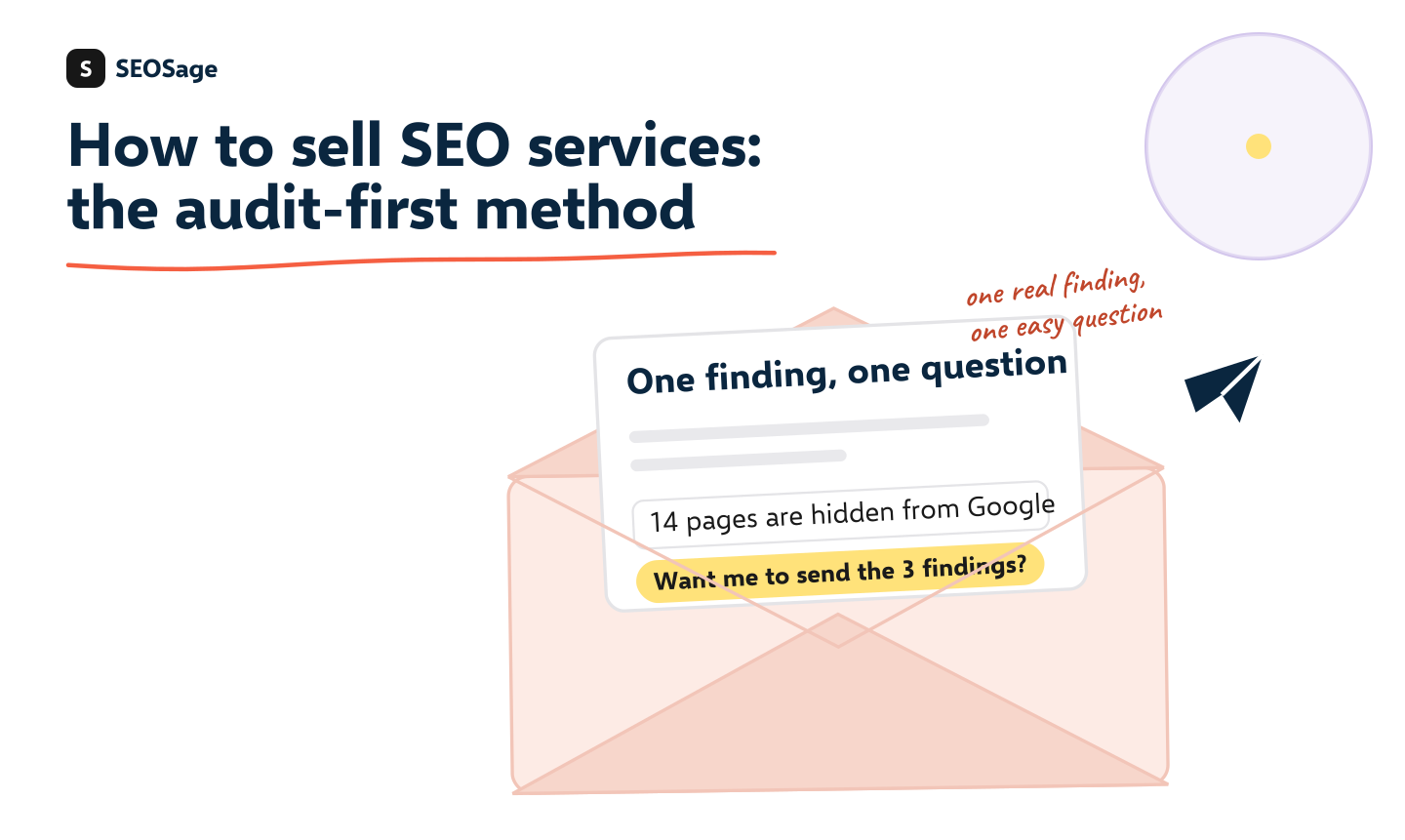
- Open with one specific finding, such as “14 pages on your site are hidden from Google”, not with your services.
- Offer a paid first project (the audit and the fixes), then a monthly retainer.
- Send a short proposal, and promise the work and the reporting, never a ranking.
- Report every month with a branded file. It is the main reason clients stay.
Why is SEO hard to sell? #
SEO is hard to sell for four reasons. It is invisible, because the work happens inside a website that the client never looks at. It is slow, because results take weeks or months. It is full of jargon, so the client cannot judge what they are buying. And it has a bad reputation, because many people have been promised rankings that never came.
The audit-first method answers all four. An audit makes the problem visible on the client’s own site. The first project shows quick, concrete progress. The findings are written in plain words. And the proposal makes no promise you cannot keep.
How do you sell SEO services? The six-step audit-first method #
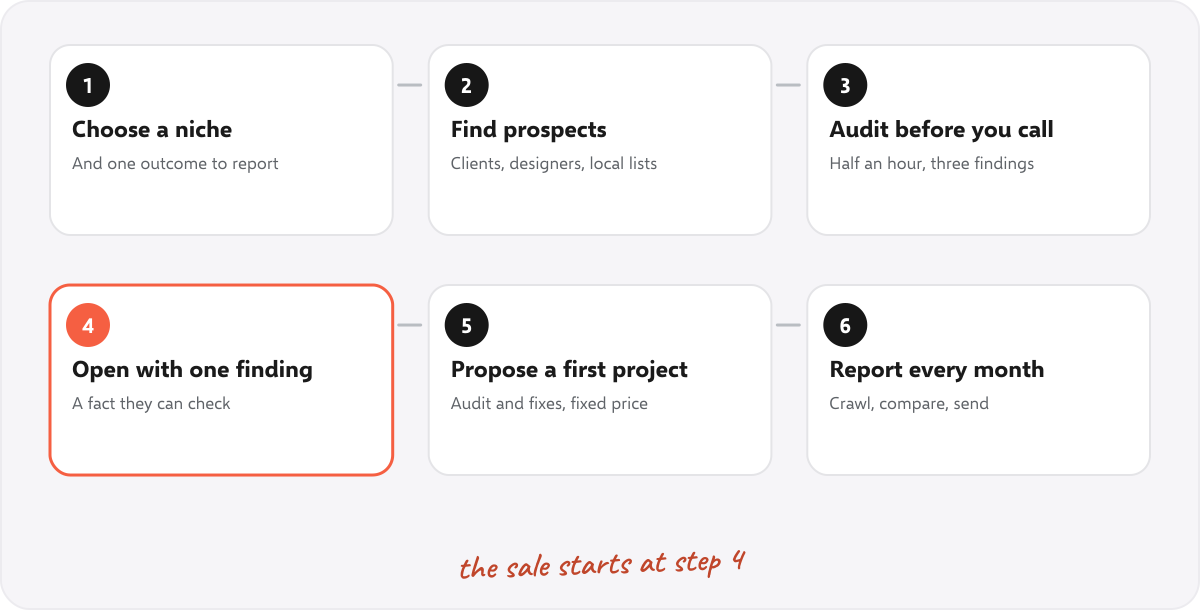
Sell SEO services in six steps: choose who you sell to, find prospects, audit before you call, open with one finding, propose a paid first project, and report every month.
Step 1: Choose who you sell to, and one outcome #
“SEO for everyone” is hard to sell. “More enquiries from Google for dentists” is easy to understand. Pick a type of business you know, and one outcome that its owner cares about, such as calls, bookings or trial sign-ups. That outcome is what you measure and report later.
Step 2: Find prospects #
Start where trust already exists, then widen the circle:
- Your own clients and past colleagues. Many already need more than what you did for them.
- Web designers and developers. They build sites and are often asked about SEO. Offer to run the audit for their clients.
- Local businesses in your niche. Look at the sites of businesses that rank on page two or three, or that have an obvious problem.
- Communities where your niche asks questions. Answer questions helpfully and let people come to you.
Step 3: Audit before you call #
Crawl the prospect’s site before the first conversation, and pick the three findings a business owner will understand. It takes about half an hour once the crawl is done. Our guide to the SEO audit explains what the audit includes, and the SEO proposal template has a 30-minute routine for it. If the prospect is a local business, see the local SEO audit.
With SEOSage, add the site as a project and crawl it. The Issues page ranks the problems, and a page audit can check a few pages quickly. The crawl runs on your own computer, with no page limit.
Step 4: Open with one finding #
The first message should be about the prospect, not about you. Lead with one specific, checkable finding and one question. A real example makes the point. When we crawled marketingly.org on 29 September 2026, the first finding was 14 pages carrying a noindex tag, which keeps them out of Google. That is a sentence a business owner understands at once.
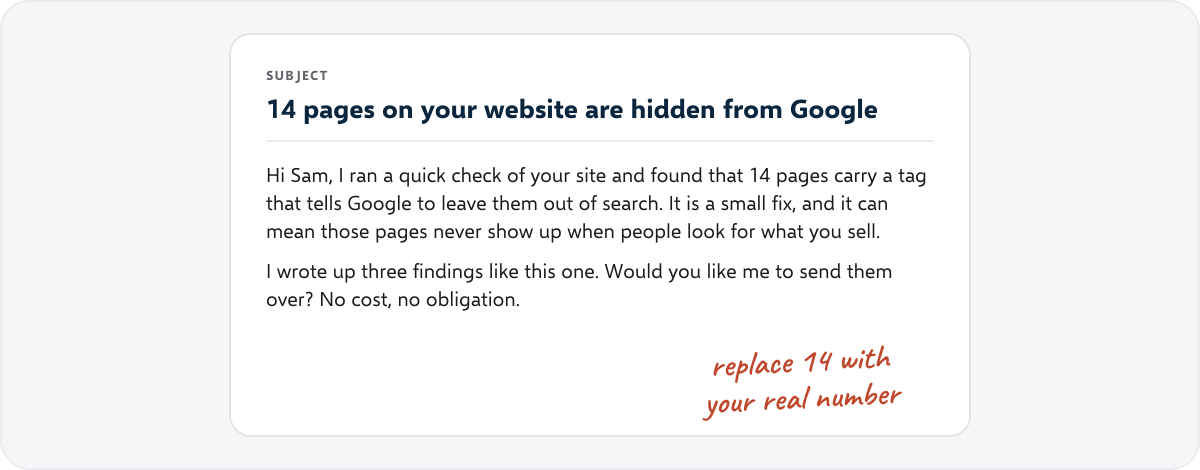
Here is a cold email you can adapt:
Subject: 14 pages on [website] are hidden from Google
Hi [name],
I ran a quick check of [website] and found that 14 pages, including [an important page], carry a tag that tells Google to leave them out of search. It is a small fix, and it can mean those pages never show up when people look for [what they sell].
I wrote up three findings like this one. Would you like me to send them over? No cost, no obligation.
[Your name]
Replace the number with the real one from your crawl. Never invent a finding. If you cannot find a problem worth mentioning, do not send the email.
Step 5: Propose a paid first project #
When a prospect replies, offer the full audit and a short list of fixes as a fixed-price first project, then a monthly retainer for the ongoing work. Write it down in a short proposal. Our free SEO proposal template has the eleven sections, an audit snapshot, a pricing table and a list of the objections you will hear.
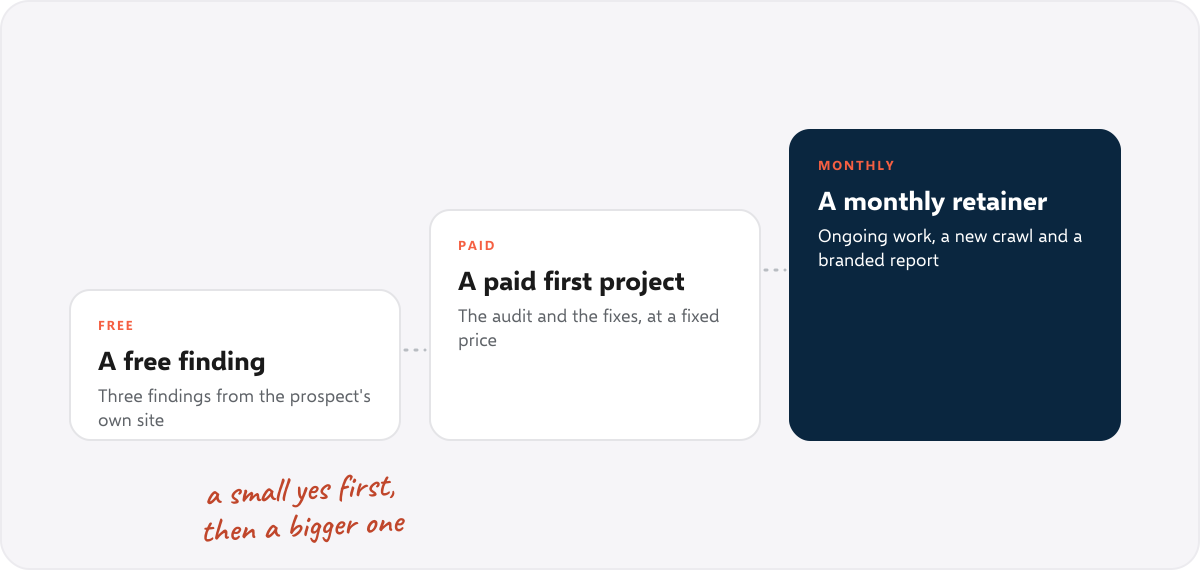
A small first project works because it is easy to say yes to, it solves a problem the client has already seen, and it gives you a chance to prove yourself before a longer commitment.
Step 6: Report every month #
Selling is not finished when the client signs. Clients who can see what happened have a reason to stay. Crawl again each month, compare it with the last crawl, and send a short branded report: what was fixed, what changed, what comes next. Our guide to the SEO client report shows the layout, and white label SEO reporting explains why your own branding matters.
What do you say on the first call? #
Use the call to understand the business, not to list your services. These five questions cover most of what you need:
- What does a good month look like for the business? (calls, bookings, sales, sign-ups)
- Which products or services matter most to you?
- Where do most customers come from today?
- Has anyone worked on the site’s SEO before? What happened?
- Who decides, and what would you need to see to say yes?
Then connect the audit to their answers. If the answer to question 2 is “our emergency repair service”, and the audit shows that page is hidden from Google, the next step is obvious.
How do you answer the objections you will hear? #
| They say | They mean | You say |
|---|---|---|
| “How long until we are number one?” | Will this pay back? | “No one can promise a position. You will see the first fixes in weeks, and I will report progress every month.” |
| “We tried SEO before.” | I do not trust it. | “Show me what was done. Here is what the audit says is still wrong, and I will prove each fix with a new crawl.” |
| “Can we just do ads?” | I want quick results. | “Ads work while you pay for them. SEO builds something that keeps bringing visits. Many businesses do both.” |
| “That is more than we expected.” | I cannot see what I get. | “Let us start with the audit and the fixes for this finding. Then we decide on the rest.” |
The proposal template has a longer table of objections.
How do you sell SEO services to local businesses? #
Local businesses buy outcomes they can feel: more calls, more bookings, more people through the door. Talk in those terms, and measure them. A local audit checks the website, the Google Business Profile and the listings, so choose findings from all three. See our local SEO audit guide for the 12 website checks. Keep the proposal short, and keep the first project small.
How can you find clients for your SEO services? #
SEO clients usually come from five places: referrals from existing clients, partnerships with web designers, outreach based on an audit, local networking, and content that answers the questions your clients ask. Use a free audit as the reason to start a conversation, since it gives something useful before you ask for anything. Do not buy lists of strangers or send the same message to hundreds of people.
How do you make money from SEO services? #
You make money from SEO in four ways, and many people combine them:
| Model | How it works | Good for |
|---|---|---|
| One-off audits | A fixed price for the audit and a list of fixes | Getting started and testing a niche |
| Fix projects | A fixed price to do the fixes | Clients with a clear, finite problem |
| Monthly retainers | A monthly price for ongoing work and reporting | Steady income |
| White label work | You deliver audits and reports under your own brand, for other agencies or designers | Adding clients through partners. See what white label SEO is |
Price by the hours the work will take times a rate you can defend, plus the tools. The proposal template has a worked example. The numbers in it are examples, not market averages.
What tools do you need? #
- A crawler for the audit. SEOSage runs on Mac and Windows, with no page limit, from $9 a month and a 14-day free trial.
- Google Search Console, which is free, to see what the client’s pages already earn. See Google’s Search Console help.
- A report format you can send every month. SEOSage exports a PDF, PowerPoint, Excel or CSV file with your logo and colours on every plan. See the white label SEO audit tool.
SEOSage does not have a keyword or backlink database, so pair it with another tool if the client’s goals are about rankings or links.
Common mistakes when selling SEO #
- Promising rankings. You do not control them, and clients remember the promise.
- Selling before you look. A pitch with no finding from the client’s own site looks like every other pitch.
- Talking jargon. Say “visits from Google”, not “organic sessions”.
- Starting with a long contract. A small paid first project is easier to say yes to.
- Going quiet after the sale. The monthly report is part of the product.
- Sending the same email to everyone. Each message needs one real finding about that business.
Summary #
To sell SEO services, audit the prospect’s site first, open with one finding they can check, offer a paid first project and then a retainer, and report every month. Choose a niche and one outcome, be honest about what SEO can and cannot promise, and use a short proposal. The audit makes an invisible service visible, which is most of the sale.
FAQ #
How do you sell SEO services to clients? #
Audit their site before you call, open with one specific finding, offer a paid first project and then a monthly retainer, and report progress every month.
How do you sell SEO services to local businesses? #
Talk about calls, bookings and visits instead of rankings. Audit the website, the Google Business Profile and the listings, and keep the first project small.
How do I find clients for my SEO services? #
Ask existing clients and past colleagues, partner with web designers, reach out with an audit finding, network locally and publish content that answers your clients’ questions.
What should an SEO proposal include? #
A summary, an audit snapshot, goals, a work plan, what you need, what is not included, a timeline, reporting, a price and next steps. See our SEO proposal template.
Is a free SEO audit a good way to get clients? #
Yes, if it contains a real finding and no obligation. Do not send an audit with invented problems, and do not send the same one to hundreds of people.
How much should I charge? #
Estimate the hours, multiply by a rate you can defend and add your tools. A fixed price for the audit and fixes, then a monthly price, is a common pattern.
Do I need to be technical to sell SEO? #
You need to understand what you are selling and to explain it in plain words. A crawler does the checking. Your job is to decide what matters and say it clearly.
How do I keep clients? #
Report every month. Show what was fixed, what changed and what is next, in a file that carries your brand.