An SEO audit is a check-up of a website that finds what stops search engines from finding, understanding and ranking its pages. A crawler visits every page, a person reads the results, and the output is a list of problems ranked by how much they matter. This guide explains what an audit includes, what happens during one, and what a real audit looks like.
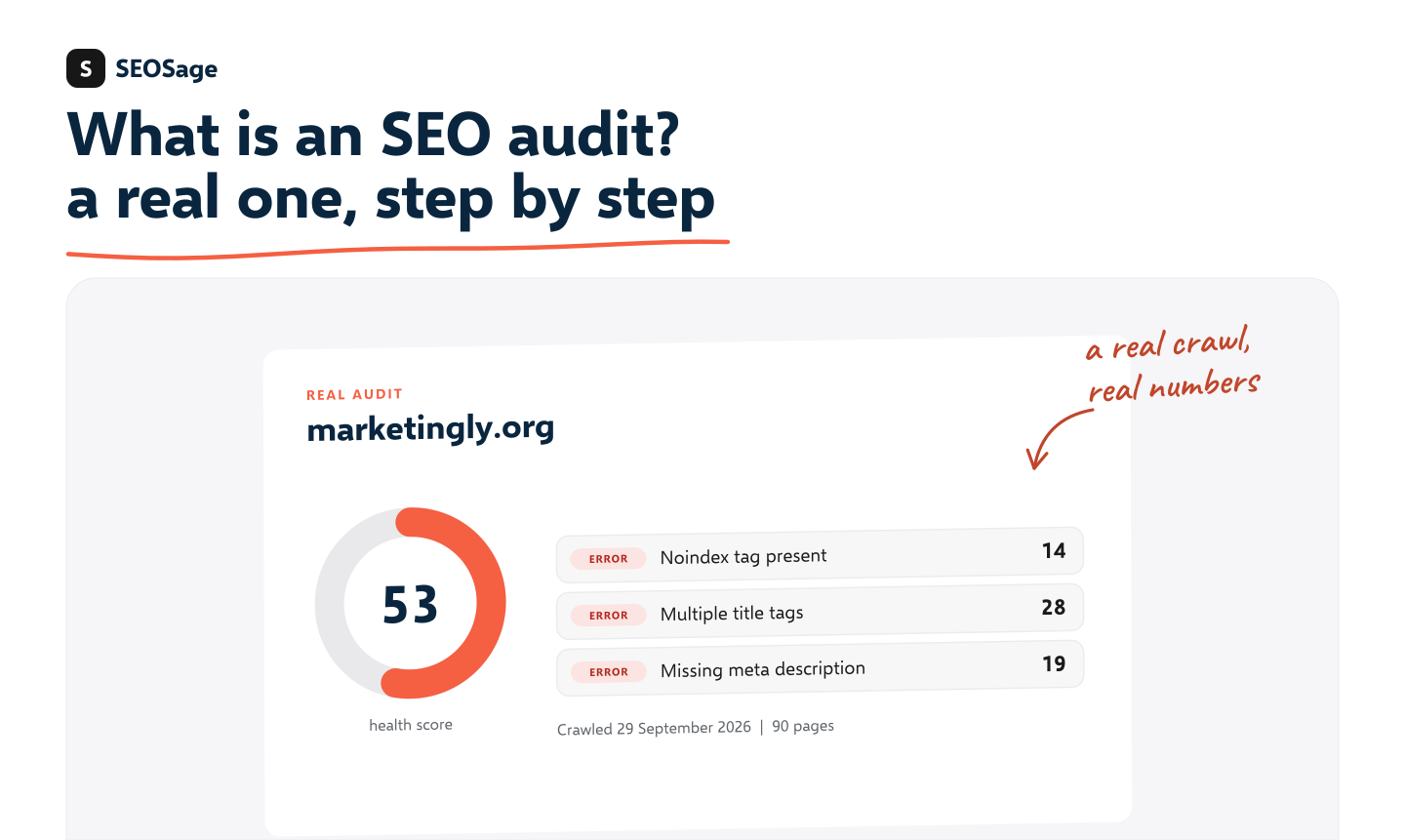
It is written by the maker of SEOSage, an SEO audit app, so the example comes from a real crawl and we say plainly what an audit can and cannot tell you.
TL;DR
- An SEO audit checks six areas: crawling and indexing, site structure and links, page basics, content, speed and mobile, and extras such as security and structured data.
- It is a list of fixes, not a strategy and not a report. The strategy says what to do next, and the report is how you present the audit to someone else.
- A crawler does the checking and a person decides what matters. The score is a guide, not the goal.
- Run a full audit when you start work on a site, after big changes, and whenever traffic drops without a clear reason. Crawl again each month to catch new problems.
- An audit cannot see backlinks, rankings or competitors. You need other tools for those.
What is an SEO audit? #
An SEO audit is a structured check of a website’s technical setup, page content and structure, to find problems that hold back its visibility in search. The result is a prioritised list of fixes.
It answers three questions. Can search engines reach every page that should be found? Do those pages say clearly what they are about? And is anything on the site broken, slow or hidden by mistake?
People use three words for related things, and mixing them up causes confusion:
| Word | What it is | Who it is for |
|---|---|---|
| SEO audit | The check itself, and the list of problems it finds | The person who will fix the site |
| SEO report | The audit, or the progress since the last one, written up for a client or a boss | The person who pays for the work. See the SEO client report guide |
| SEO strategy or proposal | The plan: what you will do, in what order, for what price | The client deciding whether to hire you. See the SEO proposal template |
What does an SEO audit include? #
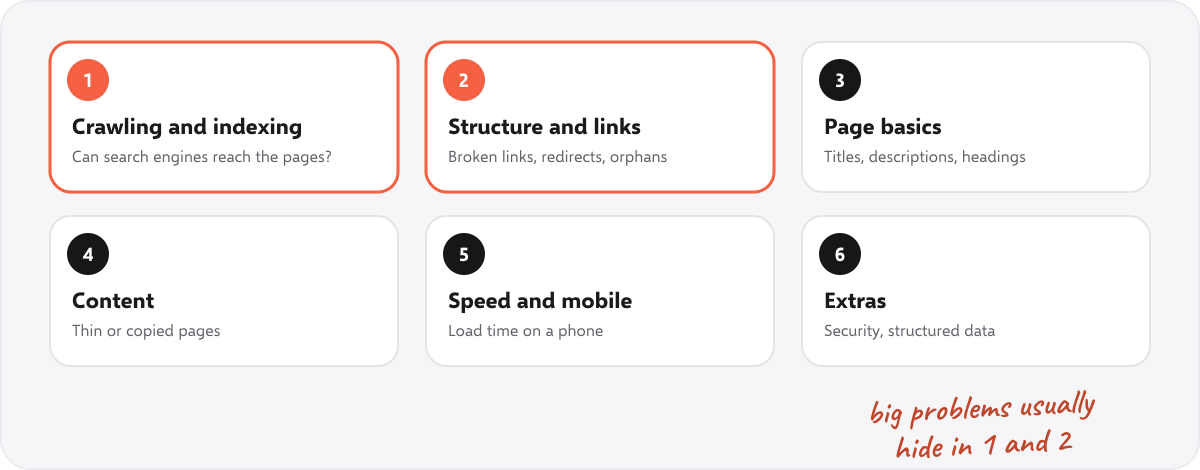
A full SEO audit covers six areas. Most audits find the most serious problems in the first two.
| Area | What it checks | Example of a problem |
|---|---|---|
| 1. Crawling and indexing | Whether search engines can reach and index the pages you want found: robots.txt, the sitemap, noindex tags, status codes | Important pages carry a noindex tag left over from the site build |
| 2. Structure and links | How pages link to each other: broken links, redirects, orphan pages, how deep pages sit | A product page that no other page links to |
| 3. Page basics | Titles, meta descriptions, headings, image text, web addresses, canonical tags | Twenty pages share the same title |
| 4. Content | Thin pages, copied text, pages that do not match what searchers want | A service page with two sentences on it |
| 5. Speed and mobile | How fast pages load and respond, and how they behave on a phone | A slow server response on the busiest pages |
| 6. Extras | Secure connection, security headers, structured data, language tags for other countries | No structured data on product pages |
A seventh area, links from other sites (backlinks), is often listed in an audit, but it needs data from outside your own website. A crawler cannot see who links to you, so a backlink check uses a different tool. SEOSage covers the six areas above and does not have a backlink database.
Our SEO audit checklist turns these areas into 24 checks, each with a free tool to test it.
What happens in an SEO audit, step by step? #
An audit follows five steps. The crawl takes minutes or hours, and the thinking takes longer.
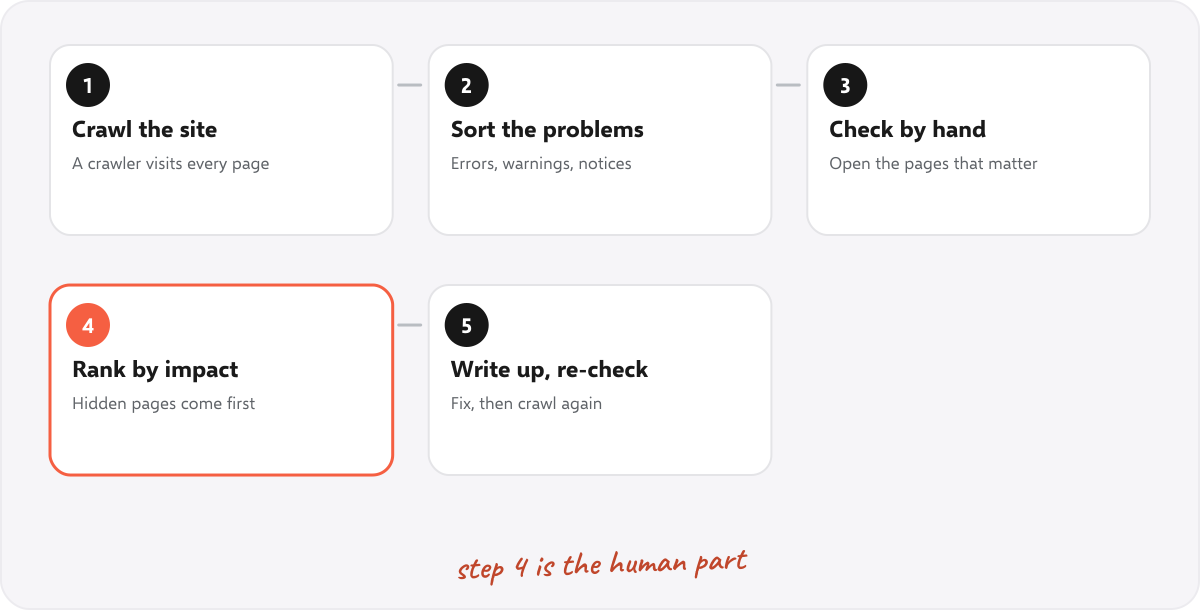
- Crawl the site. A crawler follows every link from the home page, like a search engine would, and records what it finds on each page: its status, title, headings, links and more. SEOSage runs this on your own computer with no page limit.
- Sort the problems. The tool groups what it found into issues, ranked by how serious they are. In SEOSage, each issue is tagged error, warning or notice.
- Check the important ones by hand. Open a few of the affected pages. A tool can say a page has no description. Only a person can say whether that page matters.
- Rank by impact. Put fixes in order by what they cost and what they bring. Anything that hides a good page from Google comes first.
- Write it up and re-check. Hand over the list, fix the items, and crawl again to prove the fixes worked.
What does an SEO audit look like? A real example #
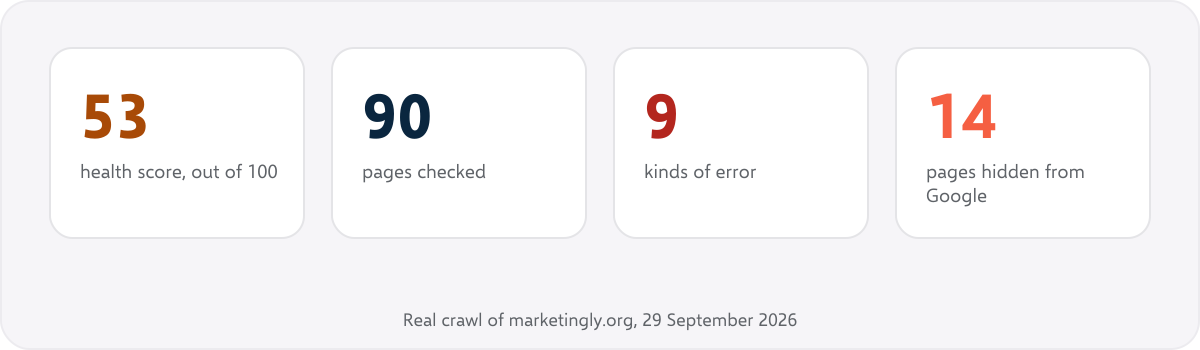
The most useful way to understand an audit is to see one. We crawled marketingly.org with SEOSage on 29 September 2026. The crawl checked 90 pages and the site scored 53 out of 100. It found 9 kinds of error, 15 kinds of warning and 4 kinds of notice.
The audit did not just list numbers. It said, in plain words, what each problem meant:
| What the audit found | Pages | What it means |
|---|---|---|
| Noindex tag present | 14 | These pages tell Google to leave them out of search. If any should bring visits, they cannot. |
| Multiple title tags | 28 | Each page has two titles, so Google may show the wrong one. |
| Missing meta description | 19 | Google writes its own summary of the page in search results. |
| Slow response time | 28 | The server takes too long to answer, which can lose visitors before the page loads. |
| 404 client error | 4 | Four addresses return an error page, and 5 pages link to a broken page. |
Notice the order. The 14 hidden pages come before the 19 missing descriptions, even though the descriptions are a bigger number. A page hidden from Google cannot rank at all, so it is the more serious problem. That ranking by impact is the part a tool cannot do for you.
The score is a guide, not the goal. Our own site, seosage.co, scored 94 in the 14 October crawl, with no errors, 93 warnings and 44 notices across 82 pages. A high score does not mean there is nothing to fix. It means nothing is broken and the rest is polish. If you hand a client one of these audits, our guide to the SEO client report shows how to write it up.
What types of SEO audit are there? #
The word “audit” is used for several jobs. The six areas stay the same, but the emphasis changes.
| Type | Focus |
|---|---|
| Technical SEO audit | Crawling, indexing, redirects, speed and security. The most common type, and the one a crawler does best. |
| On-page and content audit | Titles, headings, text and whether each page answers its search |
| Ecommerce SEO audit | Product and category pages, filters, removed products. See our ecommerce SEO audit checklist |
| SaaS SEO audit | The pages that bring trials. See the SaaS SEO audit checklist |
| Backlink audit | Who links to you, and whether any links are harmful. Needs a backlink tool. |
| Pre-launch audit | A check of a new site before it goes live, on your own computer or a staging address |
When should you do an SEO audit? #
Do a full audit when you take on a site, because you cannot fix what you have not found. Do another after any big change, such as a redesign, a platform move or a rebuilt menu. Do one whenever traffic drops and the cause is not obvious, because a stray noindex tag or a broken redirect is a common culprit.
After that, crawl once a month and compare it with the last crawl. The compare view in SEOSage shows what was fixed, what is new and what got worse, so a small monthly check replaces a big yearly clean-up.
Can you do an SEO audit yourself? #
Yes. A basic audit needs three things: a crawler, Google Search Console and an hour to read the results. You do not need to be technical to find the problems. You need to be careful about which ones matter.
- A crawler checks every page. A free tool checks one page at a time, and the free SEO tools on this site cover robots.txt, sitemaps, redirects, noindex tags and more.
- Search Console shows which pages Google has indexed and which already get visits. Use it to rank the fixes.
- A speed test such as Google’s PageSpeed Insights checks how a page loads for real visitors.
Hire someone when the site is large, when you need a client-ready report, or when you do not have the time. Many freelancers and agencies run audits for clients with their own branded reports. See the white label SEO audit tool.
What can an SEO audit not tell you? #
An audit finds problems. It does not guarantee results, and it does not do the rest of SEO for you.
- It cannot promise rankings. Fixing problems removes what holds a site back. It does not push it up on its own.
- It cannot see your backlinks or your competitors unless it uses outside data.
- It cannot choose your keywords. Keyword research is a separate job.
- It cannot judge your content’s quality. A crawler can flag a page with too little text. It cannot say whether the text is any good.
A tool can still help you read the results. SEOSage has a Claude integration, Ask Claude, so you can ask questions about your crawl in plain English. It reads the crawl data. It does not replace your judgement about what matters to your business.
What should you do after the audit? #
- Fix what blocks pages from Google first: noindex tags, robots.txt rules, broken redirects.
- Fix broken links and dead pages that get visits.
- Improve titles, descriptions and content on the pages that matter most.
- Crawl again and compare, so you can show what changed.
- Repeat monthly. New problems appear whenever a site changes.
If you sell audits, the next step is turning the audit into work. Our free SEO proposal template has an audit snapshot section built in.
Summary #
An SEO audit is a check-up that finds what holds a website back in search. A crawler checks six areas, a person ranks the problems by impact, and the result is a list of fixes. It is not a strategy and not a promise of rankings. Audit when you start, after big changes and when traffic drops, then crawl monthly to catch new problems.
FAQ #
What is an SEO audit in simple words? #
It is a health check for a website. A tool visits every page and lists what is broken, hidden or missing, so you can fix it in order of importance.
What is included in an SEO audit? #
Six areas: crawling and indexing, site structure and links, page basics such as titles and descriptions, content, speed and mobile, and extras such as security and structured data. A backlink check is sometimes added, using a separate tool.
How long does an SEO audit take? #
The crawl takes minutes for a small site and a few hours for a very large one. Reading the results and ranking the fixes takes longer, from an hour for a small site to a few days for a big one.
How much does an SEO audit cost? #
Agencies price audits by the hours the work takes, so the cost depends on the size of the site. If you do it yourself with SEOSage, plans start at $9 a month with a 14-day free trial.
How often should you do an SEO audit? #
Do a full audit when you start work on a site and after any big change. Then crawl every month and compare with the last crawl.
What is the difference between an SEO audit and an SEO report? #
The audit is the check and its list of problems. The report is how you present it, or the progress since last time, to a client or a boss.
Can ChatGPT do an SEO audit? #
Not on its own. An AI assistant cannot crawl your whole site by itself. It can help you read crawl results. With SEOSage, Ask Claude reads your crawl data and answers questions about it.
Is there a free SEO audit? #
Yes. Free tools check one page or one part of a site at a time, such as the free SEO tools on this site. A full-site audit needs a crawler. SEOSage has a 14-day free trial.
Do I need a technical background? #
No. You need to read the results carefully and decide what matters to the business. Our SEO audit checklist explains each check in plain words.