SEO ROI (return on investment) is how much profit search engine optimisation brings in compared with what it costs. The formula is: SEO ROI = (extra profit from organic search minus the cost of SEO) divided by the cost of SEO, times 100. If SEO costs $12,000 a year and brings in $26,000 of extra profit, the ROI is 117%. Below is how to work out each number, a month-by-month example, three types of business compared, and the month SEO pays for itself.
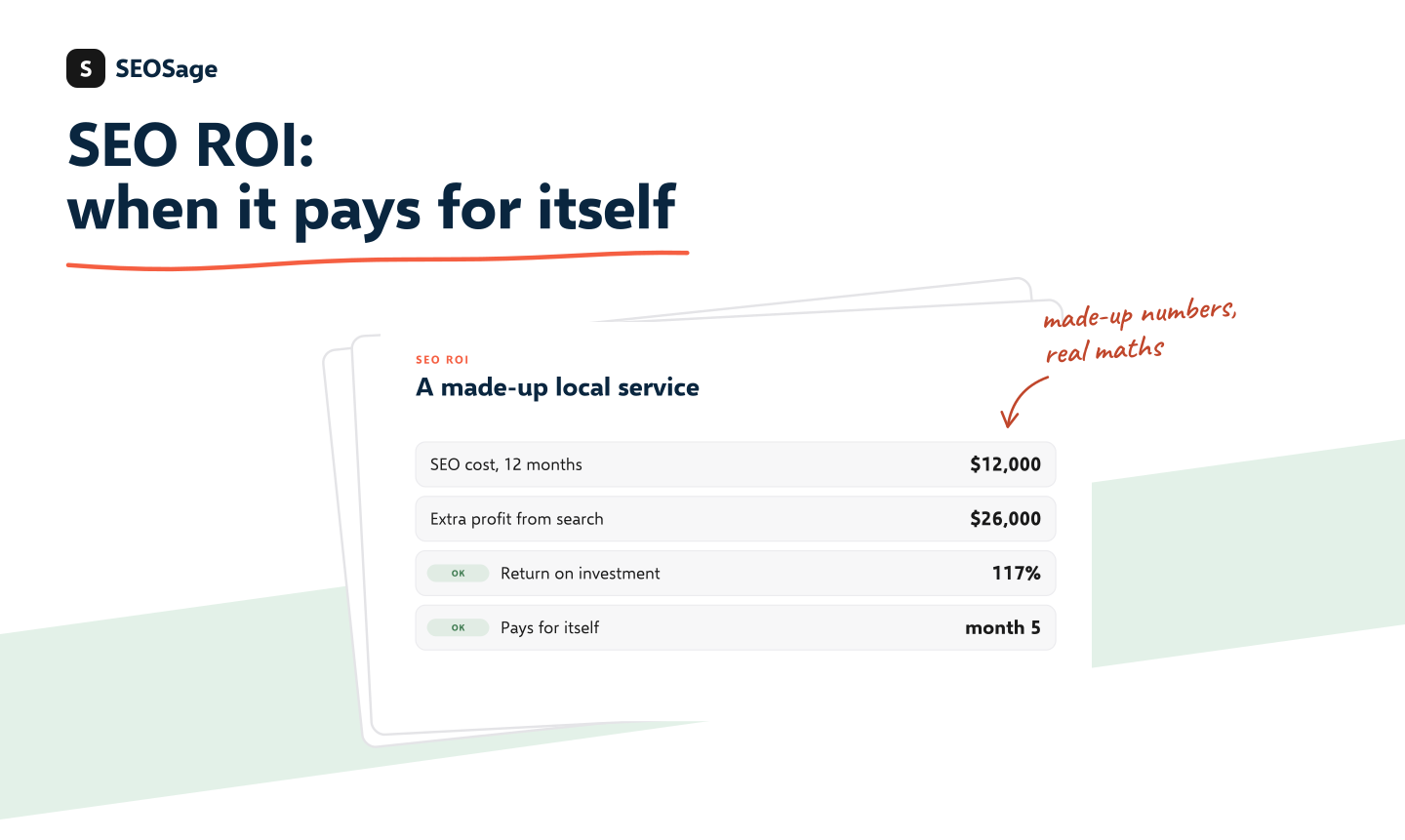
It is written by the maker of SEOSage, an SEO audit app with branded client reports. Every example uses made-up businesses and our free SEO ROI calculator, so you can check each number with your own.
TL;DR
- SEO ROI = (extra profit from organic search – SEO cost) / SEO cost x 100.
- Use profit, not revenue. A $100 sale at a 30% margin earns $30, and the $30 is what pays for SEO.
- Count every cost: the agency or freelancer, staff time, tools, content and links.
- Traffic from SEO builds slowly, so the first months earn little. Look at the month SEO pays for itself, not only the yearly ROI.
- In our three made-up examples, a local service paid back in month 5 and B2B software in month 4. A low-margin online store did not pay back within a year until both its order value and its traffic growth doubled.
This guide is part of our series on how to sell SEO services. To win the work, start from the free SEO proposal template.
What is SEO ROI? #
SEO ROI is the return on investment of search engine optimisation: the money organic search earns for a business compared with the money spent to earn it, as a percentage. An ROI of 0% means SEO paid for itself and no more. An ROI of 100% means every $1 spent came back as $2. A negative ROI means SEO cost more than it earned in that period.
It matters because SEO competes for the same budget as ads, content and sales. A clear ROI number, worked out the same way every month, is what lets a business owner or a client decide whether to keep paying for it.
The SEO ROI formula #
SEO ROI = (extra profit from organic search – cost of SEO) / cost of SEO x 100
- Extra profit from organic search: the value of the sales or customers that came from Google and other search engines because of the SEO work, times your profit margin.
- Cost of SEO: everything you paid to do it, over the same period.
Why profit and not revenue? Many guides use revenue, which makes ROI look bigger than it is. If an online store sells $10,000 of goods at a 30% margin, it keeps $3,000. If SEO cost $2,500, the ROI on revenue looks like 300%, but the ROI on profit is 20%. Use your real margin. If you do not know it, use revenue and say so.
How to calculate SEO ROI in 5 steps #
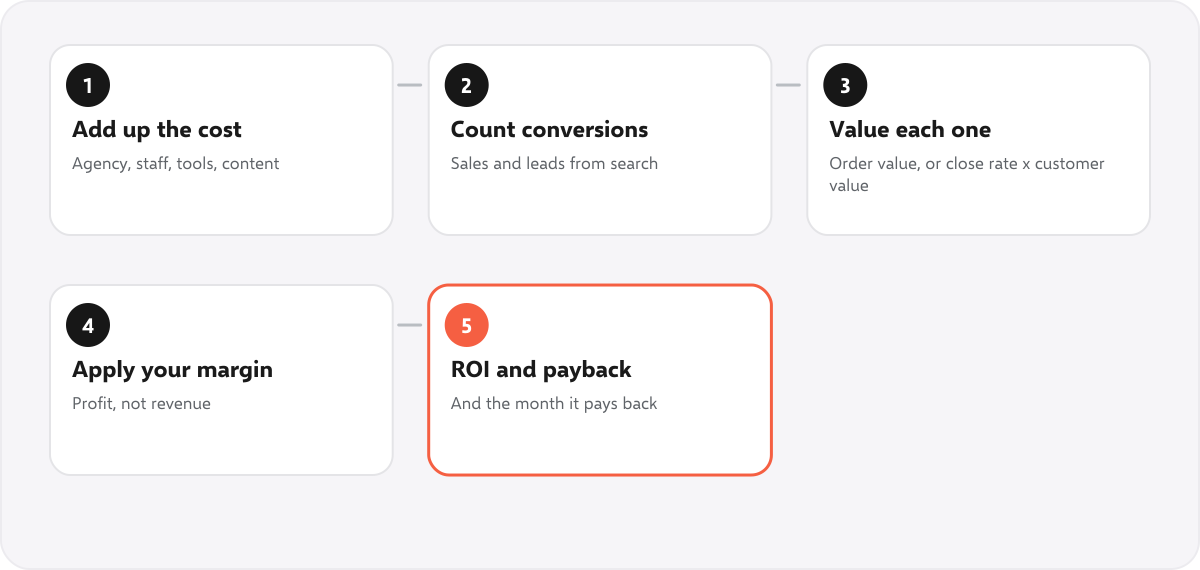
1. Add up the cost of SEO #
Include everything spent on SEO over the period:
- The agency or freelancer fee, including any setup or audit fee. Google’s own advice on hiring an SEO is a good checklist for what that fee should cover.
- Staff time: hours spent on SEO, times the hourly cost of each person.
- Tools: crawlers, rank trackers, keyword tools.
- Content: writers, editors, design and video.
- Link building and digital PR.
2. Count the conversions from organic search #
A conversion is the action that makes you money: a sale, a booked call, a form sent. In Google Analytics, mark those actions as key events, then look at key events by the “Organic Search” channel. For a lead business, also count how many of those leads became customers, from your sales records or CRM.
3. Put a value on each conversion #
- Online sales: the order value. Google Analytics shows revenue by channel if your shop sends purchase data.
- Leads: the share of leads that become customers, times what a customer is worth. If 25% of leads buy and a customer is worth $800, each lead is worth $200.
4. Apply your profit margin #
Multiply the value by your profit margin to get the profit. A business with a 50% margin keeps half of each sale.
5. Work out the ROI and the payback month #
Put the profit and the cost into the formula. Then go one step further and work out the month SEO pays for itself: the first month when the profit so far is at least the cost so far. Because SEO grows slowly, a yearly ROI can look good while the first six months lose money, and the payback month shows that. Google’s SEO Starter Guide notes that some changes take effect in hours and others take several months.
A worked example, month by month #
A made-up local service business pays an agency $1,000 a month. Organic visits grow evenly from 500 a month to 1,500 a month over a year. 4% of visitors send an enquiry, 25% of enquiries become customers, a customer is worth $800, and the business keeps 50% as profit.
- Extra visits over the year: 6,500.
- Extra leads: 260. Extra customers: 65.
- Extra revenue: $52,000. Extra profit at 50%: $26,000.
- Cost: $12,000. ROI: ($26,000 – $12,000) / $12,000 x 100 = 117%.
- It pays for itself in month 5.
| Month | Extra visits | Extra customers | Extra profit | Running total |
|---|---|---|---|---|
| 1 | 83 | 0.8 | $333 | -$667 |
| 2 | 167 | 1.7 | $667 | -$1,000 |
| 3 | 250 | 2.5 | $1,000 | -$1,000 |
| 4 | 333 | 3.3 | $1,333 | -$667 |
| 5 | 417 | 4.2 | $1,667 | $0 |
| 6 | 500 | 5 | $2,000 | $1,000 |
| 7 | 583 | 5.8 | $2,333 | $2,333 |
| 8 | 667 | 6.7 | $2,667 | $4,000 |
| 9 | 750 | 7.5 | $3,000 | $6,000 |
| 10 | 833 | 8.3 | $3,333 | $8,333 |
| 11 | 917 | 9.2 | $3,667 | $11,000 |
| 12 | 1,000 | 10 | $4,000 | $14,000 |
The running total is the extra profit so far minus the SEO cost so far. It falls for the first two months, because traffic has barely started to grow, reaches $0 in month 5 (the month SEO has paid for itself) and is positive from month 6. Try it with your own numbers.
Three types of business compared #
The same maths gives very different answers for different businesses. These three are made up, and each uses one set of numbers you can change in the calculator.
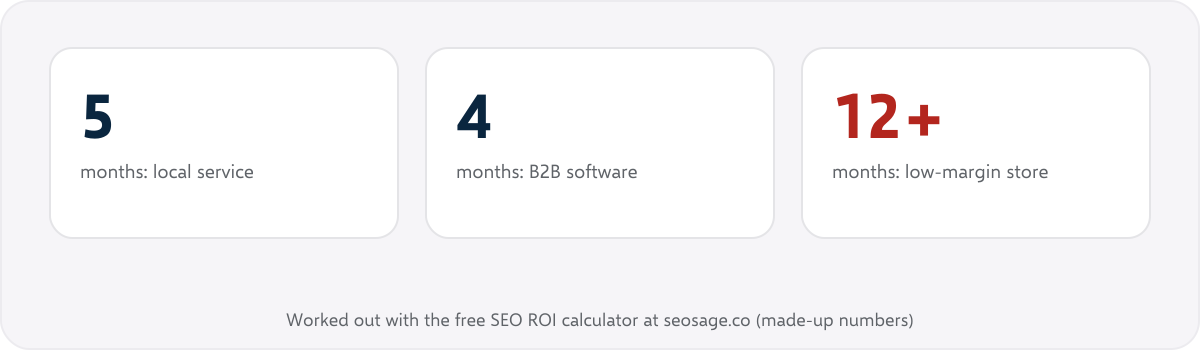
| Example (made-up) | SEO cost, 12 months | ROI over 12 months | Pays for itself |
|---|---|---|---|
| Local service, leads | $12,000 | 117% | Month 5 |
| B2B software, leads | $38,000 | 228% | Month 4 |
| Online store, sales | $25,500 | -68% | Not within 12 months |
What we assumed for each one:
- Local service: SEO costs $1,000 a month. Visits from search grow from 500 to 1,500 a month. 4% become leads, 25% of leads buy, a customer is worth $800 and the margin is 50%.
- B2B software: $3,000 a month plus $2,000 setup. Visits grow from 2,000 to 4,000 a month. 2% become leads, 10% buy, a customer is worth $6,000 in the first year and the margin is 80%.
- Online store: $2,000 a month plus $1,500 setup. Visits grow from 5,000 to 9,000 a month. 1.5% buy, the average order is $70 and the margin is 30%.
The local service and the software company pay back fast because each customer is worth a lot and the margin is high. The online store sells small orders at a thin margin, so the same growth in traffic earns far less profit than it costs.
What does a low-margin store need? #
We changed one thing at a time for the online store:
| The same store, changing one thing | ROI over 12 months | Pays for itself |
|---|---|---|
| As above | -68% | Not within 12 months |
| Orders of $140 | -36% | Not within 12 months (around month 30) |
| Traffic grows to 13,000 | -36% | Not within 12 months (around month 30) |
| Orders of $140 and traffic to 13,000 | 28% | Month 10 |
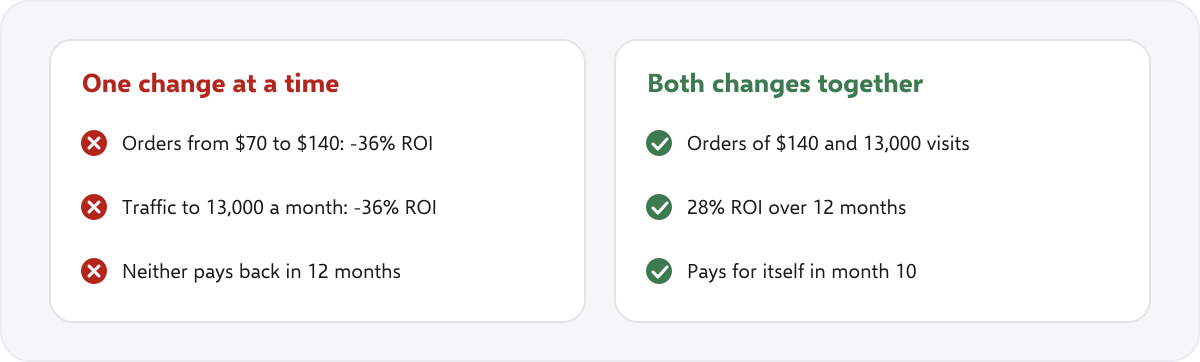
“Around month 30” assumes sales stay at their month-12 level after the first year. For a store with small orders and a thin margin, more traffic alone is not enough, and nor are bigger orders alone. It takes both, or a longer time frame. That is worth knowing before you sign up for SEO, and worth telling a client before you sell it.
How to forecast SEO ROI #
- Start from the searches you can win. List the keywords you can realistically rank for, with their monthly searches, and estimate how many clicks a top-five position would bring.
- Let traffic grow slowly. Most sites do not jump to the target in month one. Our calculator grows traffic evenly from today to the target, which is a fair middle case.
- Use three cases. Work out a low, a likely and a high case by changing the target visits and the conversion rate. A plan that only works in the high case is a risky plan.
- Check it every month. Replace the forecast with real numbers as they come in.
How to show SEO ROI to clients #
Clients want one short answer, not a dashboard. Each month, send the same six lines:
- What SEO cost so far.
- Extra organic visits, compared with before.
- Extra leads or sales from organic search.
- The profit from those, at the client’s margin.
- The ROI so far.
- The month it pays for itself, or when it is expected to.
The calculator’s “Copy summary” button writes those lines for you to paste into an email or a proposal. Be clear about what is an estimate, and keep the method the same every month so the numbers can be compared.
What is a good SEO ROI? #
There is no single good number, and averages published online use very different methods. Three practical tests work better:
- Is it above 0%? Then SEO earned more profit than it cost in that period.
- Does it beat the alternative? Compare it with what the same money earns in paid ads, measured the same way.
- When does it pay for itself? A plan that pays back in month 5 is a different decision from one that pays back in month 20, even if both reach the same ROI in the end.
Why SEO ROI is hard to measure #
- It takes months. Work done today often pays off months later, so a short period understates the ROI.
- Buyers visit more than once. Someone may find you through search, then come back later by typing your name. Google Analytics’ attribution settings decide which visit gets the credit.
- Brand searches are not all SEO. People who search for your name would often have found you anyway. Count them separately if you can.
- Some sales happen offline. Phone calls and shop visits need tracking, or a question on the form: “How did you find us?”
How does SEOSage help show the return on SEO? #
SEOSage is a desktop SEO audit app for Mac and Windows. It does not track revenue, but it shows the work and the results that lead to it: a full crawl of every page with the problems ranked, a comparison between two crawls so you can show what was fixed, your Search Console clicks and impressions next to the crawl, and reports in your own brand to send to clients. Pair it with the free SEO ROI calculator for the money side. It is free for 14 days.
Common SEO ROI mistakes #
- Using revenue instead of profit. It makes the ROI look several times bigger than it is.
- Leaving out costs. Staff time, tools and content all count.
- Judging too early. In the first months, the ROI is usually negative even when the plan is working.
- Counting every lead as a sale. Use how many leads really become customers.
- Changing the method each month. Then the numbers cannot be compared.
Summary #
SEO ROI is (extra profit from organic search – cost of SEO) / cost of SEO x 100. Add up every cost, count the conversions from organic search, value them, apply your margin, and then look at both the ROI and the month SEO pays for itself. In our made-up examples, a local service paid back in month 5 and B2B software in month 4, while a low-margin store needed bigger orders and more traffic together to pay back within a year. Try your own numbers in the free calculator.
FAQ #
What is ROI in SEO? #
It is the profit that organic search brings in, minus what SEO cost, divided by what SEO cost, as a percentage.
How do you calculate SEO ROI? #
Add up the cost of SEO, count the sales or customers from organic search, put a value on them, apply your profit margin, then use the formula: (profit – cost) / cost x 100.
How long does SEO take to pay for itself? #
It depends on the business. In our made-up examples it was 4 to 5 months for high-value customers, and more than a year for a low-margin store. Work it out for your own numbers.
What is a good ROI for SEO? #
Anything above 0% earned more than it cost. Compare it with what the same money earns in ads, and look at the month it pays for itself.
Should SEO ROI use revenue or profit? #
Profit. Revenue makes the ROI look bigger than the money the business actually keeps.
Can you forecast SEO ROI? #
Yes, roughly. Estimate the traffic you can win from the searches you target, let it grow gradually, and work out a low, a likely and a high case.
Sources #
- Investopedia: What Is Return on Investment (ROI) and How to Calculate It
- Google Analytics Help: Mark events as key events
- Google Analytics Help: Get started with attribution
- Google Search Central: SEO Starter Guide
- Google Search Central: Do you need an SEO?
Recommended #
- How Much to Charge for SEO: 4 Pricing Models and a Simple Formula
- SEO Retainer: What to Include, How to Structure It and Handle Scope Creep
- Free SEO Proposal Template (With Example)
- SEO KPIs: 12 Metrics to Track and Report to Clients
- Monthly SEO Report Template: Free Word File and Sample PDF
- How to Sell SEO Services: The Audit-First Method
- SEO Contract Template: Free Word Agreement, Clause by Clause
Run your own SEO audit
SEOSage crawls every page of your website, lists what is wrong and turns it into a report you can send to a client.