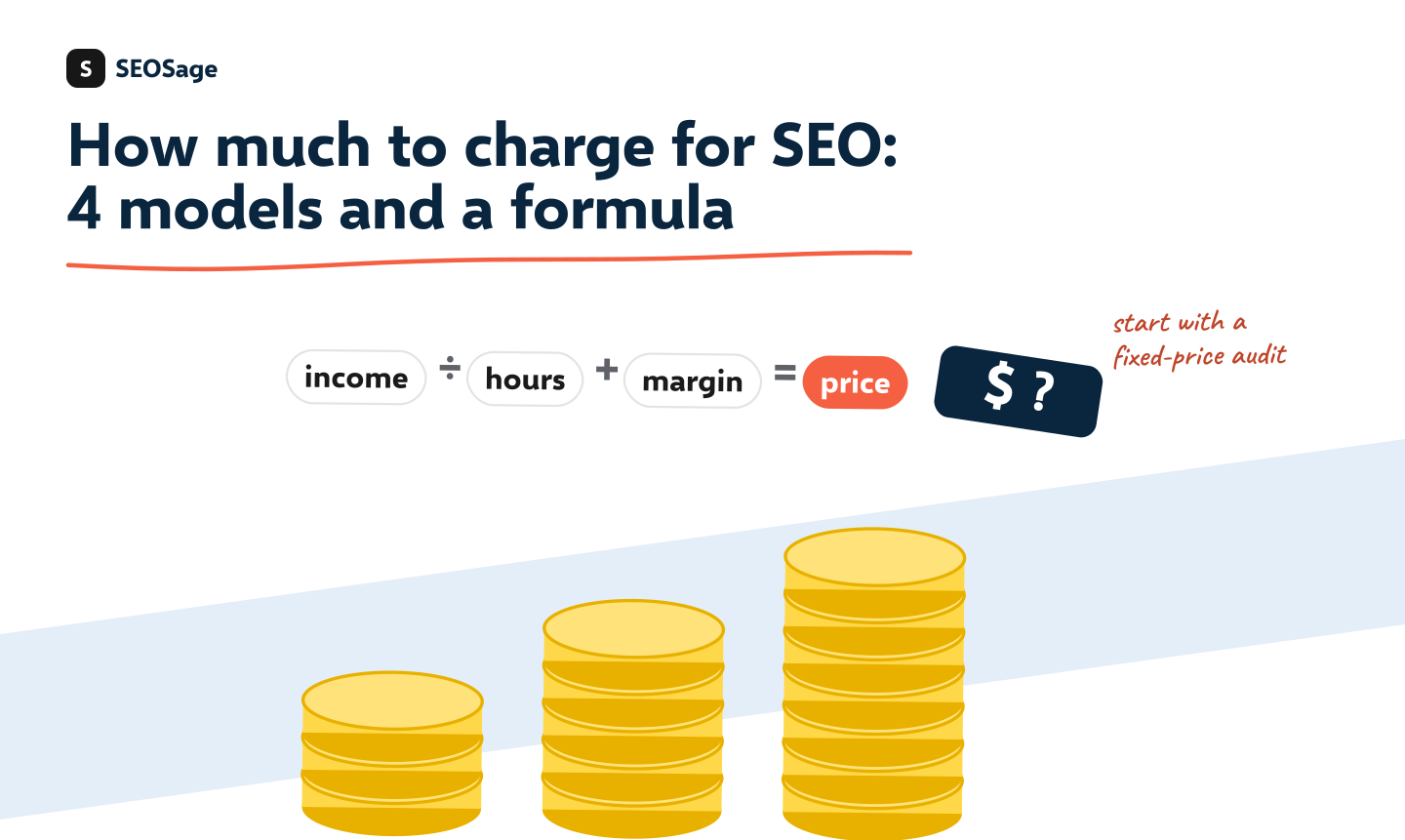
How much to charge for SEO depends on your costs, your time, the size of the site and what a result is worth to the client. There is no single price, and rates differ widely by country and by who you serve. What works is a method: pick one of four pricing models, work out your price from your own hours and costs with a simple formula, and check it against what the client gains. This guide shows how, with a worked example that uses made-up numbers.
It is written by the maker of SEOSage, an SEO audit app with branded client reports. We do not quote market rates, because published ranges are mixed, often unsourced and differ by place. Check what agencies near you charge, and treat our numbers as examples.
TL;DR
- Four pricing models: a fixed price (audit or project), a monthly retainer, an hourly rate and pay for results. The last one is risky for you.
- Price from your own numbers: the income you need, the billable hours you really have, your costs and a margin.
- Compare the result with what the client gains. A new customer may be worth far more than your fee.
- Start new clients with a fixed-price audit. It lowers the risk for both sides.
- Write the scope and the price in a proposal and a contract, and never price below what you can deliver well.
What are the four ways to price SEO? #
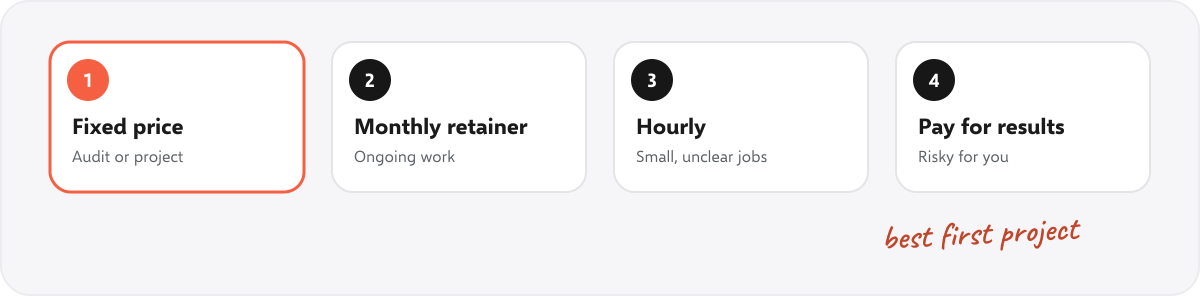
| Model | How it works | Good for | Risk |
|---|---|---|---|
| Fixed price | One price for a defined piece of work, such as an audit or a site fix | A first project, and work with a clear end | If the scope grows, you lose money. Write the scope down |
| Monthly retainer | A set fee each month for a set list of tasks and a report | Ongoing SEO, since results take months | The client may expect results faster than is realistic. Agree what you report |
| Hourly | You bill the hours worked, at a rate | Small jobs and unclear work | Clients may watch the clock, and you earn less when you work faster |
| Pay for results | You are paid only if a target, such as a ranking, is reached | Rarely a good idea | You carry all the risk, and rankings depend on things you do not control |
Most independent SEOs and small agencies use a fixed-price audit to start and a monthly retainer after it. See how to sell SEO services for how the audit leads to the retainer.
What is a simple formula for pricing? #
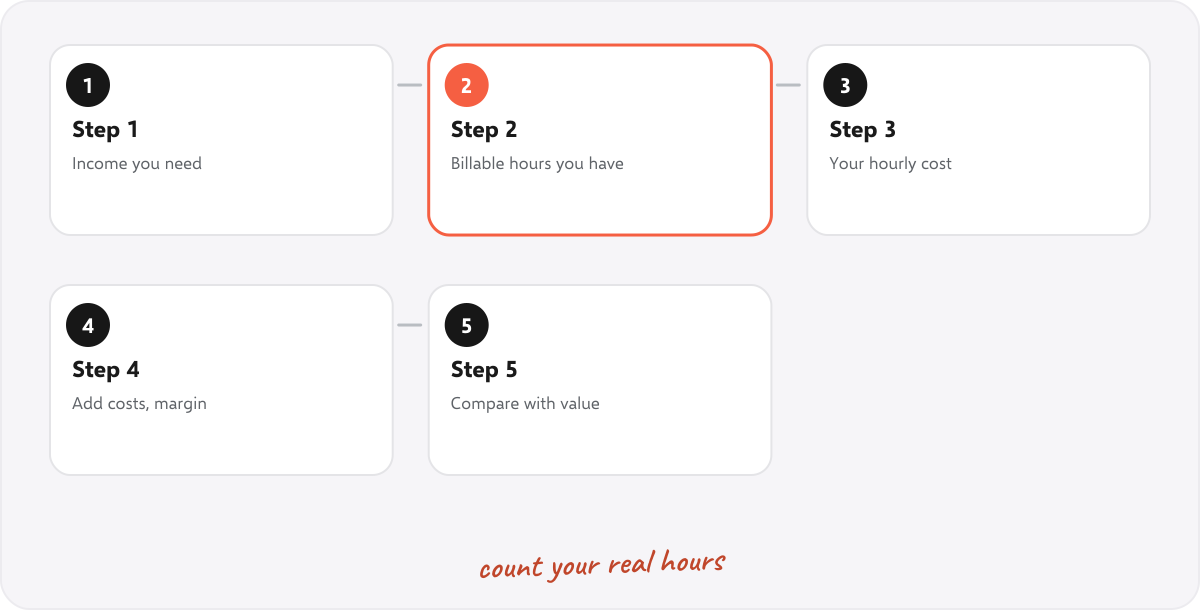
- Income you need. What you want to earn in a year, plus costs such as tools, tax and time off.
- Billable hours you really have. Not 40 a week. Subtract selling, admin, learning and gaps between clients. Track your own time for a few weeks. Many freelancers find well under 40 hours a week are billable.
- Your hourly cost. The income you need divided by the billable hours.
- Add costs and a margin. Tools, software, subcontractors and a cushion for jobs that take longer than planned.
- Compare with value. If a new customer is worth a lot to the client, a price that looks high to you may be small to them.
What does the formula give? A worked example #
These numbers are made up, to show the sums. Use your own.
| Step | Example |
|---|---|
| Income needed, including costs and tax | 60,000 a year |
| Billable hours in a year | 900 (about 18 a week for 50 weeks) |
| Cost per billable hour | 60,000 / 900 = 67 |
| Add a margin of 20% for risk and growth | 67 x 1.2 = about 80 per hour |
| A site audit that takes about 10 hours | 10 x 80 = 800 for a fixed-price audit |
| A retainer of 12 hours a month | 12 x 80 = 960 a month |
Your numbers will differ. The point is to start from your own time, not from a number you saw on someone’s website. To estimate the hours for an audit, crawl the site first: the number of pages and the number of problems tell you more than a guess. See how to write a website audit report for what the audit produces.
How do you compare the price with the value? #
Ask the client what a new customer is worth, and how many they get from search today. If a customer is worth 500 and the work could bring a few a month, a retainer of 960 can pay for itself. If a customer is worth 5, it cannot. Do not promise this result. Use it to check that the price makes sense for both sides, and to decide whether the client is a good fit. See SEO KPIs for what to report as proof.
What changes the price? #
- Size of the site. More pages mean more to check and fix.
- State of the site. A site with many errors needs more work first.
- Competition. A crowded market needs more content and more time.
- Who does the work. If the client’s developer makes the fixes, your hours fall.
- Reporting and meetings. A weekly call costs more than a monthly report. See the monthly SEO report template.
- Your experience and your niche. A specialist can charge more.
How do you present the price? #
- Put it in a proposal, with the scope, the reporting and what is not included. See our SEO proposal template.
- Offer two or three options, such as a starter, a standard and a full service. Many clients choose the middle option.
- Explain what the price buys in hours and tasks, not in promises.
- Record it in a contract. See the SEO contract template.
- Raise your prices for new clients as your results and demand grow.
How does SEOSage help with pricing? #
SEOSage is a desktop SEO audit app for Mac and Windows that crawls on your own computer with no page limit. A crawl before you quote shows how many pages the site has and how many problems you would need to fix, so your price rests on real numbers. It saves every crawl, so the first one proves the starting point, and it exports a branded PDF, PowerPoint, Excel or CSV report with your logo on every plan. Plans start at $9 a month, and the free trial lasts 14 days. It does not set your price for you.
Common pricing mistakes #
- Counting 40 billable hours a week. Selling, admin and gaps take a large share.
- Copying a competitor’s price. They have different costs and a different aim.
- Pricing below what you can deliver well. It leads to rushed work and resentment.
- Agreeing to pay for results only. You carry all the risk.
- No written scope. The price then grows without the fee.
- Never raising prices. Increase them for new clients when you can.
Summary #
To price SEO, choose a model (a fixed-price audit to start, then a retainer), work the price out from your own income, hours and costs, add a margin and check it against what the client gains. Write the scope in a proposal and a contract, and do not promise results.
FAQ #
How much should I charge for SEO? #
It depends on your costs, your time, the site and the value to the client. Use the formula above, and check what agencies near you charge.
What are the SEO pricing models? #
Fixed price, monthly retainer, hourly rate and pay for results.
Should I charge hourly or a retainer for SEO? #
A retainer suits ongoing work, because SEO takes months. Hourly suits small, unclear jobs.
How much should I charge for an SEO audit? #
Estimate the hours from a crawl, multiply by your rate and add a margin, and quote a fixed price.
Should I charge based on results? #
Rarely. Rankings depend on things you do not control, so you carry the risk.
How do I raise my SEO prices? #
Raise them for new clients first, and show your results and your process when you explain why.