An SEO case study is a short story of one client: where they started, what you found, what you did and what changed, with numbers and sources. It is proof you can help, and it is often what turns a maybe into a yes. Below is a structure of eight sections, the numbers to use and where to get them, plus a free editable template and a filled-in example.
It is written by the maker of SEOSage, an SEO audit app with branded client reports. A crawl before and after the work is the easiest source of honest numbers.
Download the free SEO case study template (Word) · See the filled-in example (PDF) · Works in Word, Google Docs and Pages. No sign-up and no email form.
TL;DR
- Use eight sections: at a glance, the challenge, what we found, what we did, the results, what we learned, a client quote and next steps.
- Show a before and an after with the same measure and the same length of time, and write the source beside every number.
- Use three kinds of number: a health score from a crawl, clicks from Search Console and a result the client cares about, such as enquiries.
- Ask for permission, mention other changes that could explain the result and never promise the same result.
- No clients yet? Write up your own site, clearly labelled, instead of inventing a client.
Why write an SEO case study? #
Buyers cannot judge SEO work from the outside, so they look for proof. A case study answers the question every prospect has: “Has this person done it before, for someone like me?” It also gives you something specific to send after a first message. Our guide to how to get SEO clients lists case studies as one of the three things to have before you start, and how to sell SEO services shows where to send one.
What are the eight sections of an SEO case study? #
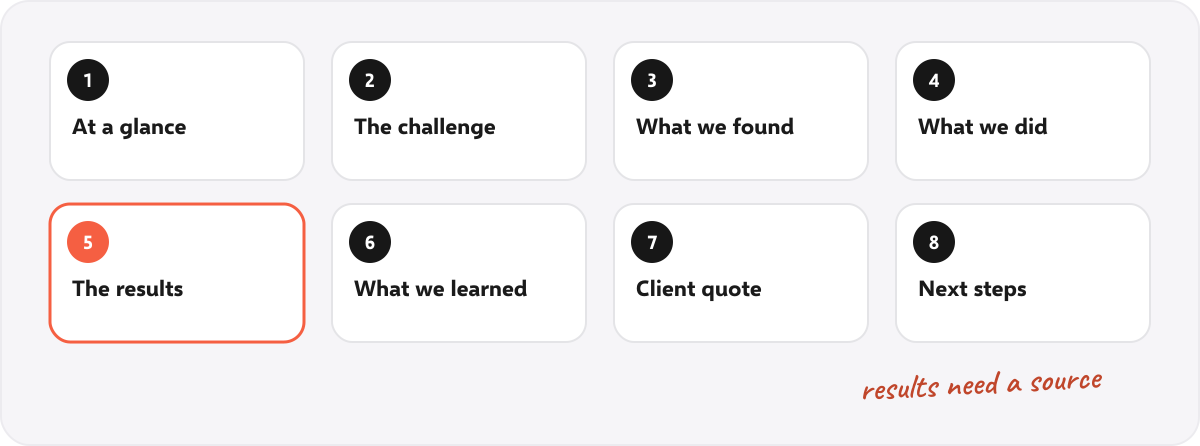
- At a glance. One sentence and three numbers. A reader should get the point in five seconds.
- The challenge. What the client wanted and where they started, with a baseline number and its date.
- What we found. The audit, in plain words. Three findings with numbers prove you looked before you acted. See what an SEO audit is.
- What we did. The actions in order, and why for each.
- The results. Before and after, on the same measure and the same time range, with sources.
- What we learned. One or two honest lessons. It makes the rest more believable.
- In the client’s words. A short quote, with permission. Skip it if you have none.
- Next steps. One clear invitation for the reader with the same problem.
Aim for one to two pages. A long case study is read less often than a short one that is specific.
Which numbers should you use, and where do they come from? #
| Number | Where to get it | Why use it |
|---|---|---|
| Health score, errors, pages checked | A site crawl before and after, for example in SEOSage. The compare view shows what was fixed. | Shows the work you did, even before search results move |
| Clicks, impressions, average position | Google Search Console, Performance report | Shows how people found the site. See SEO KPIs |
| Enquiries, sales, sign-ups from search | The client’s analytics, call log or order records | The result the client cares about most |
| Pages fixed or added | Your task list and the compare view | Makes the work concrete |
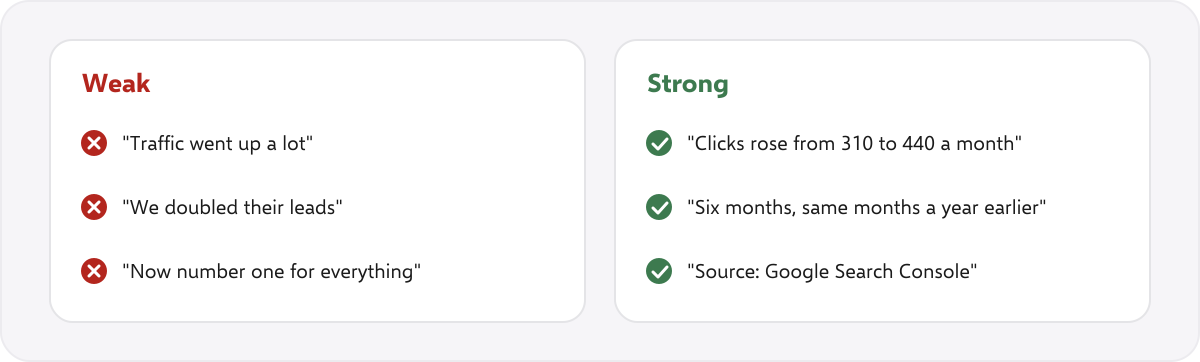
Choose the same date range before and after, for example six months to the same six months a year earlier if the business is seasonal. Write the range and the source in the text, so a reader can check.
How do you keep a case study honest? #
- Get permission. Use the client’s name only in writing. If they say no, make it anonymous: “a local bakery”.
- Mention other changes. A redesign, a sale or a season can move the numbers. Say so.
- Do not promise. Write “this is what happened here”, never “you will get the same”.
- Do not invent. A made-up case study is easy to spot and costs you the trust you wanted. If you show a sample, label it as one.
- Use the same measure. Do not compare a health score before with clicks after.
How do you write one, step by step? #
- Pick a client with a clear result and a good relationship, and ask for permission.
- Collect the numbers from your first crawl, your latest crawl and Search Console, with dates.
- Fill in the template, section by section. Replace every yellow bracket and delete the tips.
- Cut. Remove anything the reader does not need to believe the result.
- Send it to the client for approval before you publish.
- Use it: on a page of your site, in proposals (see our SEO proposal template) and in the first reply to a prospect.
What does a finished SEO case study look like? #
We made a one-client example for a made-up bakery, with made-up numbers, so you can see the layout and the level of detail. Open the example (PDF). Every name and number in it is invented, and it says so on the first page.
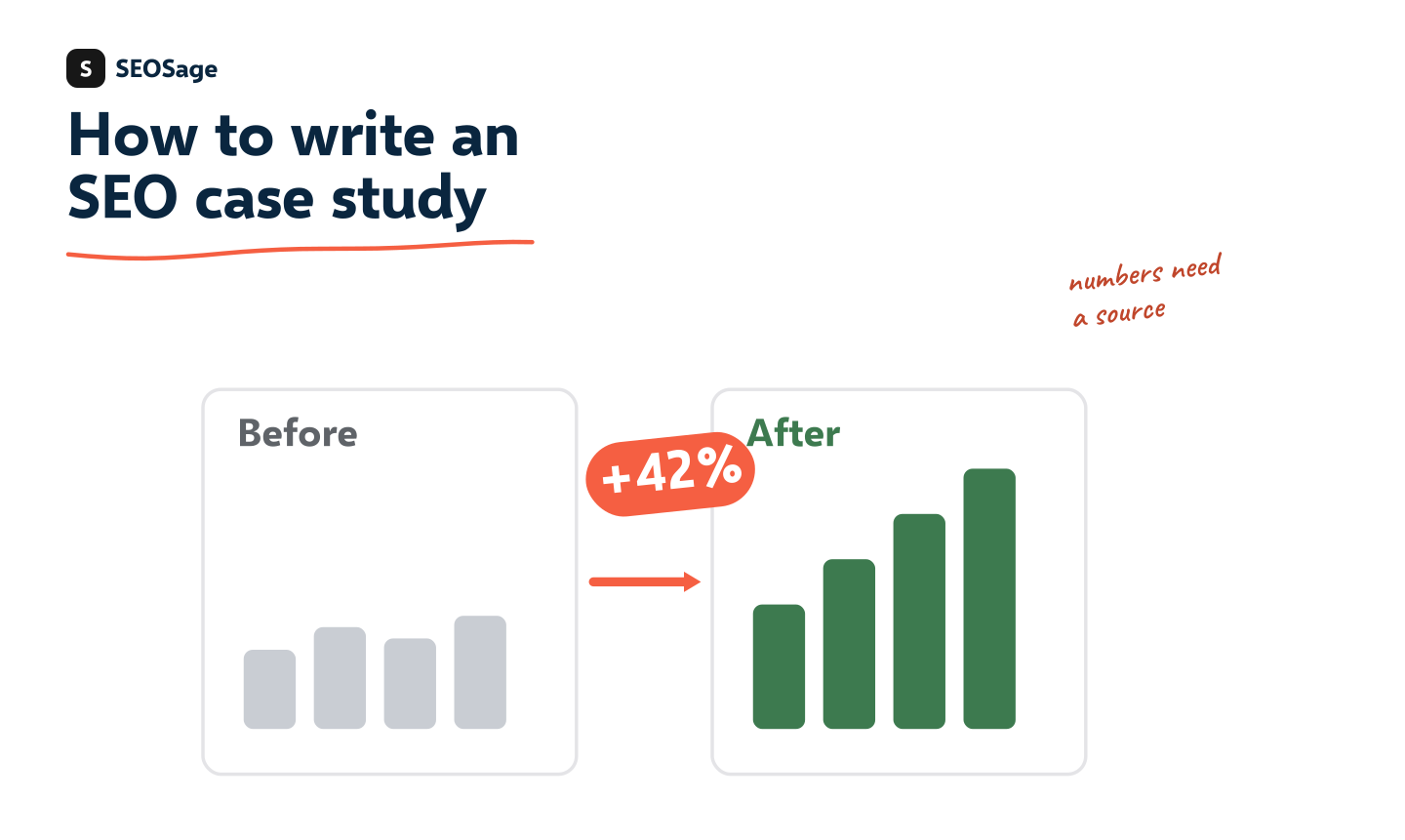
For a real baseline, here is one from our own work. A SEOSage crawl of marketingly.org on 29 September 2026 gave a health score of 53, with 14 pages hidden from Google by a noindex tag. That is the “before” half of a case study: a dated, checkable starting point. The “after” is a second crawl once the fixes are made. See the SEO client report for how to show it.
What if you have no client case studies yet? #
- Write up your own site. Crawl it, fix it, crawl again and tell the story, clearly labelled as your own site.
- Do one small project for a friendly local business at a low price, in return for permission to write it up.
- Show a sample audit of a site in your niche, labelled as a sample. See how to do an SEO audit.
How does SEOSage help with a case study? #
SEOSage is a desktop SEO audit app for Mac and Windows that crawls on your own computer with no page limit. It saves every crawl, so the first one becomes your “before”. The compare view shows what changed in the next one, and it exports a branded PDF, PowerPoint, Excel or CSV report with your logo. Plans start at $9 a month, and the free trial lasts 14 days. It does not measure clicks or rankings by itself, so you take those from Search Console.
Common mistakes in SEO case studies #
- No baseline. Without a “before”, there is no story.
- Vanity numbers. A rise in impressions alone does not help a client’s business.
- Too long. Cut to what makes the result believable.
- No source or date. Numbers without them are easy to doubt.
- Hiding other changes. It looks dishonest when a reader finds out.
- No next step. End with one clear invitation.
Summary #
A good SEO case study is short and specific. Use eight sections, one before and after on the same measure and time range, a source beside each number, and honest notes about anything else that changed. Use our free template to write it in an hour.
FAQ #
How do I write an SEO case study? #
Use eight sections: at a glance, the challenge, what we found, what we did, the results, what we learned, a client quote and next steps. Add numbers with sources and dates.
What should an SEO case study include? #
The client, the starting problem with a number, the audit findings, the actions, a before and after on the same measure, lessons and a next step.
How long should an SEO case study be? #
One to two pages is enough. Specific and short is read more often than long.
Is there a free SEO case study template? #
Yes. Download ours in Word. It also opens in Google Docs and Pages.
How do I write a case study with no clients? #
Write up your own site, or a small project for a friendly business, or a clearly labelled sample audit. Never invent a client.
Which metrics should I use? #
A health score from a crawl, clicks from Search Console and a result the client cares about, such as enquiries. See SEO KPIs.
Do I need the client’s permission? #
Yes, in writing. If they say no, make the case study anonymous.
Recommended #
- How to Get SEO Clients: 9 Ways and a Weekly Routine
- How to Sell SEO Services: The Audit-First Method
- SEO Client Report: What to Include (Real Example)
- SEO KPIs: 12 Metrics to Track and Report to Clients
Run your own SEO audit
SEOSage crawls every page of your website, lists what is wrong and turns it into a report you can send to a client.